
Essential Technical SEO Checklist for Your Website: Comprehensive Audit and Optimization Guide
By Frank Wiebe, Cinderix
Technical SEO is the foundation of search visibility and user engagement. This checklist highlights the key systems—crawlability and indexing, site speed, structured data, security, and AI‑assisted audits—and gives concise, actionable guidance to strengthen your site’s technical baseline and improve measurable organic performance.
Key Takeaways
- Improve crawlability and indexing to ensure pages are discoverable.
- Optimize site speed (images, code, CDNs) to boost rankings and UX.
- Keep meta tags, headings, and alt text clear and relevant.
- Use structured data to enable rich snippets and higher CTRs.
- Require HTTPS and solid security practices to build trust.
- Leverage AI tools to automate audits and prioritise fixes.
How Do Crawlability and Indexing Impact Your Website’s SEO Performance?
Crawlability and indexing determine whether search engines can find and surface your content. Poor crawling or indexation creates visibility gaps and reduces the value of your content investments.
Quantitative frameworks—using server logs and Search Console signals—help teams measure crawl efficiency and index yield, and prioritise remediation where it returns the most value.
Technical SEO: Crawl & Indexation Performance
This article proposes a quantitative, engineering-oriented diagnostic framework that integrates server log telemetry and Google Search Console signals to measure three operational components of SEO performance: crawl efficiency, indexation yield, and visibility volatility, with the goal of translating organic growth constraints into measurable bottlenecks and testable interventions. The framework introduces metrics such as crawl waste rate by URL class, crawl-to-index yield, canonical consistency ratio, discovery and refresh latency, position volatility index for query clusters, and CTR efficiency conditioned on position distribution, and it specifies a reliability workflow in which thresholds and targets are defined as service-level objectives for organic visibility rather than as ad hoc improvement goals.
Building Reliable Organic Search Systems: Log-Based Analysis of Crawl Waste and Indexation Performance, 2025
What Are the Key Elements of a Crawlability and Indexing Checklist?
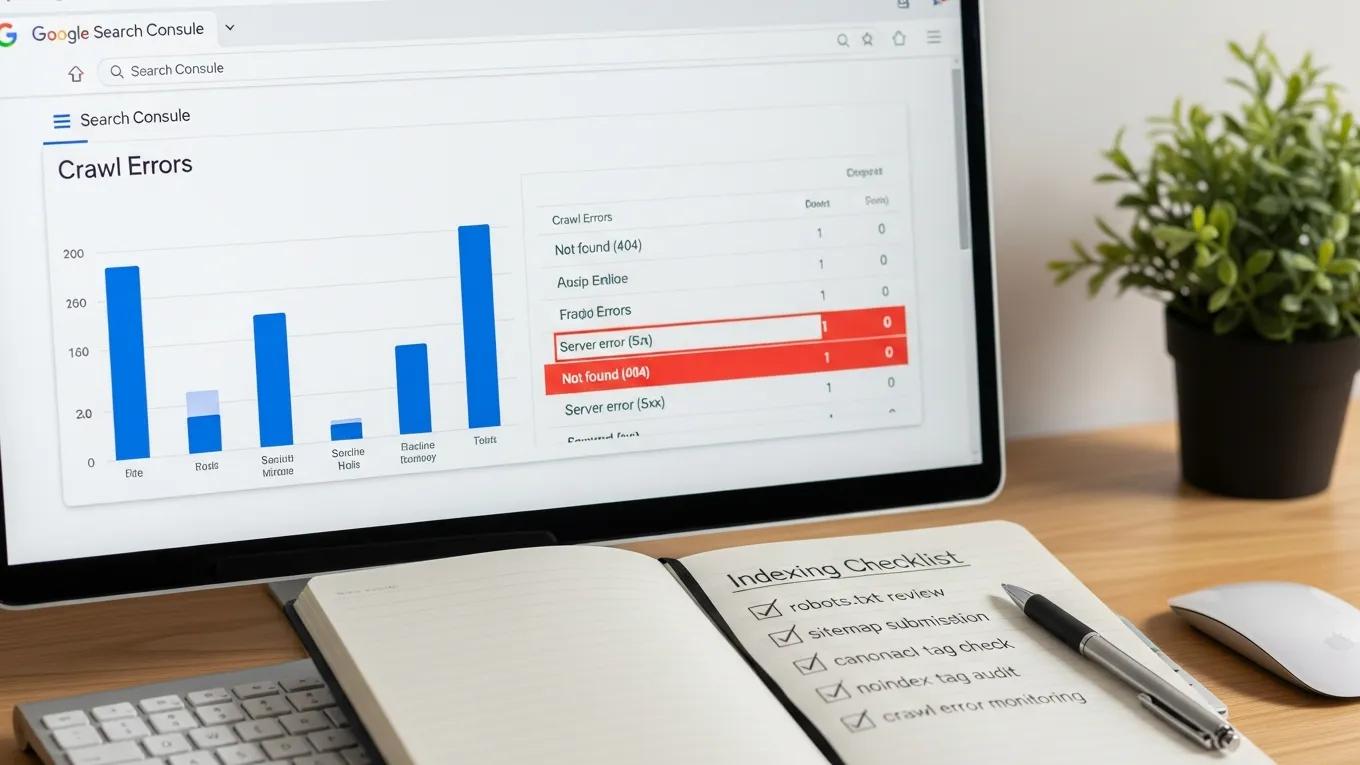
Keep a short, verifiable checklist to prevent indexing loss:
- Crawl Errors: Monitor Search Console and resolve errors promptly.
- Robots.txt: Allow important sections and block irrelevant ones correctly.
- Sitemaps: Maintain and submit an accurate XML sitemap.
These controls reduce indexation gaps and stabilise organic visibility.
How to Audit and Improve Your Website’s Crawlability and Indexing Status?
Run regular scans, review logs, and track remediation to ensure improvements stick.
- SEO Tools: Use Search Console and site crawlers to find issues.
- Server Logs: Inspect bot behaviour to detect crawl barriers.
- Remediation: Prioritize fixes and verify them after deployment.
Consistent audits lower crawl waste and increase the chance that targeted pages are indexed.
Which Technical SEO Best Practices Enhance Site Performance and User Experience?
Implement a small set of best practices to reduce delivery friction and improve engagement.
How Does Site Speed Optimization Influence SEO Rankings?

Site speed is a ranking factor and a major UX signal. Faster pages reduce bounce rates and increase sessions. Focus on a few high-impact actions:
- Image optimization: Compress and deliver appropriately sized assets.
- Minify code: Remove unused CSS/JS and defer noncritical scripts.
- CDN: Serve assets from edge locations to cut latency.
What On-Page SEO Factors Are Critical for Technical Optimization?
Clear metadata and structure make it easier for search engines to interpret pages.
- Meta tags: Concise, keyword-relevant titles and descriptions.
- Header tags: Use headings to reflect content hierarchy.
- Alt text: Descriptive alt attributes for accessibility and context.
Consistent implementation improves semantic clarity and relevance signals.
How Can Structured Data and Security Measures Strengthen Your Website’s SEO?
Structured data and strong security both increase discoverability and trust, improving presentation in search results and user confidence.
What Are the Benefits of Implementing Structured Data Markup?
Structured data enables machine-readable descriptions and better search features:
- Enhanced visibility: Helps search engines interpret content for rich results.
- Rich snippets: Adds context to listings and can increase CTR.
- Higher engagement: More informative results attract more clicks.
Standards like Schema.org make structured data practical for most sites.
Structured Data Markup for Semantic Web SEO
Structured Data Markup allows Web developers to embed semantics in HTML pages, thus enabling clients (search engines, client apps etc.) to distil machine-readable resource descriptions from HTML code. This approach emerged from the Semantic Web paradigm as a powerful alternative to traditional Web scraping. Its enablers are dedicated HTML extensions (e.g., RDFa) and controlled vocabularies (e.g., Schema.org). Originating in a different context, Enterprise Modelling methods rely on diagrammatic means for describing and analysing an enterprise system in terms of key properties and conceptual abstractions. Hence, both the Semantic Web and Enterprise Modelling paradigms share a common interest in machine-processable semantics towards the goal of elevating semantics-awareness in information systems and decision support. Inspired by this overlapping, the paper proposes a mechanism for streamlining semantics between Structured Data Markup and enterprise modelling methods. Towards this goal, it employs the Resource Description Framework and the Agile Modelling Method Engineering Framework.
Streamlining structured data markup and agile modelling methods, AM Ghiran, 2017
Why Is HTTPS and Website Security Essential for SEO Site Performance Optimization?
HTTPS and robust security are baseline requirements: they protect users, signal trust, and are recognised by search engines as positive signals.
- Trust: HTTPS reassures users and browsers.
- Ranking signal: Secure sites are favoured by search engines.
- User safety: Protect user data and reputation.
How Does AI Integration Transform Technical SEO Audits and Optimization?
AI automates detection, prioritisation, and pattern recognition, allowing teams to scale audits and respond faster to issues.
Industry studies show AI helps surface optimisation opportunities and reduce repetitive manual work.
AI in SEO: Revolutionizing Digital Marketing
The integration of Artificial Intelligence (AI) into Search Engine Optimization (SEO) practices has ushered in a new era of digital marketing, characterized by transformative innovations and ethical considerations. This paper delves into the profound impact of AI on SEO, elucidating its multifaceted role in revolutionizing traditional approaches to optimizing online visibility and user engagement. Through advanced algorithms and machine learning techniques, AI-powered SEO tools offer unparalleled capabilities, including enhanced efficiency in keyword research, content optimization, and trend analysis. Moreover, AI enables personalized content creation tailored to individual user preferences, driving increased traffic and conversion rates.
Optimizing SEO with AI: Achieving Success Through Responsible Innovation, S Paul, 2024
What AI-Driven Tools Enhance the Website SEO Audit Checklist?
AI tools extend audit coverage and prioritise recommendations so teams focus on high-impact fixes.
- Automated auditing: Platforms that surface technical issues at scale.
- Predictive analytics: Forecast trends from historical data.
- Content tools: Suggest optimisations aligned with best practices.
How to Leverage AI for Continuous Technical SEO Improvement?
Use AI for monitoring, predictive modelling, and rapid adaptation to algorithm changes to keep your technical baseline healthy.
- Data analysis: Extract actionable signals from user and performance data.
- Predictive insights: Anticipate shifts and prioritise effort.
- Continuous adaptation: Automate routine checks and alerting.
Integrating AI into a technical SEO programme improves efficiency and supports ongoing optimisation. For more information on improving your website’s SEO, visit Cinderix.
Frequently Asked Questions
What is the difference between crawlability and indexing?
Crawlability is a crawler’s ability to access pages; indexing is the process that stores and retrieves those pages for search results. Both are required for visibility.
How often should I perform a technical SEO audit?
Audit at least twice a year and after major site changes, migrations, or strategy shifts.
What tools can I use for technical SEO audits?
Use Google Search Console, SEMrush, Ahrefs, and Screaming Frog to monitor crawl behaviour, performance, and structural issues.
How does mobile optimization affect technical SEO?
Mobile optimisation is essential due to mobile-first indexing—use responsive design and mobile performance testing to protect mobile engagement.
What role does user experience play in technical SEO?
UX affects technical SEO through page speed, navigation, and device compatibility; improvements lower bounce rates and increase session length.
Can structured data impact my website’s click-through rates?
Yes. Structured data can generate rich snippets that make listings more informative and increase CTR.
What are some common technical SEO mistakes to avoid?
Avoid neglecting speed, skipping an XML sitemap, misconfiguring robots.txt, omitting HTTPS, and ignoring mobile and crawl errors.
Conclusion
Focus technical SEO on crawlability, indexation, performance, structured data, security, and AI‑enabled monitoring. Regular audits and prioritized remediation convert technical liabilities into measurable gains in visibility and user satisfaction. Apply the checklist above and integrate continuous monitoring to maintain improvements.