
By Cinderix Editorial Team · Updated 2026-08-01
Google Ads captures high-intent searches from customers actively seeking services, making it the stronger choice for local service businesses needing immediate results.
Google Ads captures high-intent searches through pay-per-click bidding on keywords like “emergency plumber near me,” while Meta Ads builds brand awareness through visual targeting on Facebook and Instagram. Local service businesses generate faster booked jobs from Google Ads. Search intent outperforms social discovery; Meta Ads works best paired with Google campaigns,
Key Takeaways
- Google Ads uses pay-per-click pricing while Local Services Ads charges per qualified lead generated.
- Local Services Ads focuses on local customers in specific geographic areas like Aylmer, Ontario.
- Google Ads reaches broad audiences through search and display networks across multiple platforms.
- Combining both Google advertising platforms maximizes visibility and lead generation for service businesses.
How Do Google Ads and Meta Ads Target Customers?
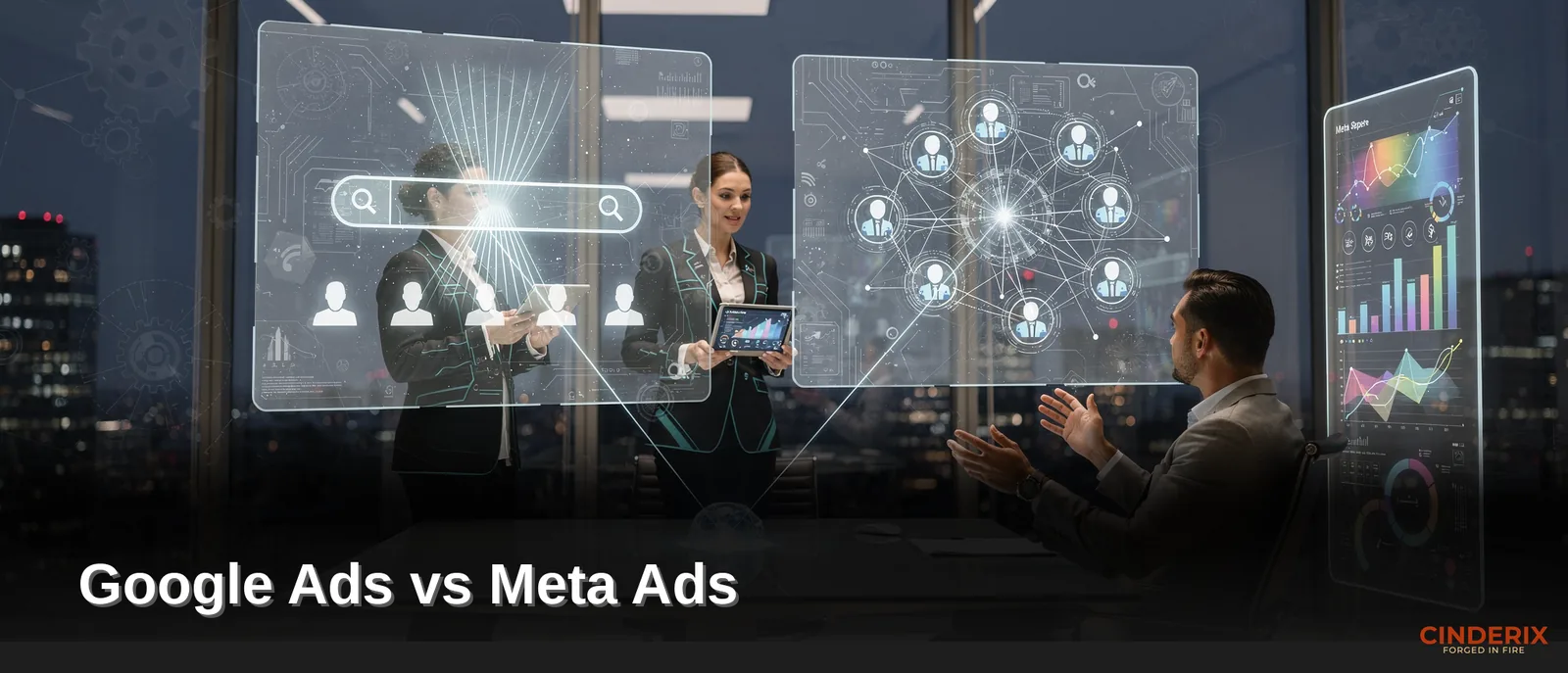
Search intent separates the two platforms entirely. Google Ads vs Meta Ads comes down to timing: Google captures homeowners actively searching for a service right now. Meta reaches prospects based on interests, behaviors, and demographic profiles rather than immediate need. A homeowner typing “roofer near me” or “emergency plumber” signals urgent intent. Google Ads places a local business directly in front of that search. Meta Ads work differently, surfacing a landscaping company or pest control provider to someone scrolling social feeds who fits a target profile but isn’t actively looking that minute.
Which platform reaches local customers faster?
Google wins for urgent, near-me searches. Local service businesses depend on visibility the moment a homeowner types a search term tied to a problem needing immediate attention.
What’s the real ad platform pros cons breakdown for contractors?
A thorough local advertising comparison shows neither platform replaces the other. Cinderix manages both Google and Meta campaigns as one done-for-you service, pairing intent-driven search visibility with interest-based social targeting so local trades capture leads at every stage.

What Are the Real Costs and Trade-Offs?
Real costs extend beyond the ad spend line item. Staff hours, reporting confusion, and missed calls after a campaign launches all factor into the true price of a paid channel. A local advertising comparison built only on cost-per-click misses half the equation.
Agencies that manage both platforms rarely treat the choice as either-or. Google Ads and Facebook Ads frequently run side by side, with the split determined by budget size and return targets rather than brand loyalty to one network. That blended approach reflects a core piece of ad platform pros cons thinking: no single platform wins every budget scenario.
Does more ad traffic create more work?
Yes, unless call handling scales with it. Leads generated through google ads vs meta ads campaigns require fast follow-up. AI-driven phone systems help convert that traffic into booked revenue instead of missed calls.
Who actually manages the campaigns day to day?
Cinderix runs on a lean, two-person team based in Aylmer, Ontario. Accounts get handled directly rather than passed down to rotating junior staff.
- Ad spend and platform fees
- Time lost to confusing performance reports
- Missed calls when volume outpaces staffing
A done-for-you structure removes the technical burden and reporting headaches that typically come with managing accounts in-house.

Should You Run Both Platforms Together?
Yes, for many local service businesses, running both platforms delivers stronger results than picking one. Combining Google-based advertising with additional channels maximizes visibility. Lead generation, rather than leaving a business dependent on a single traffic source. A roofer who only runs search ads misses the homeowners scrolling Instagram after a storm. A plumber who only runs social ads misses the customer typing “emergency plumber near me” at 2 a.m.
Cinderix does not assume both platforms fit every business from day one. A fit assessment happens before any ad dollars move. Spend only goes toward channels that match the business’s service area and demand patterns. That evaluation prevents wasted budget on a platform that will not perform for a given trade or region.
How does the process start?
Every engagement opens with a Done-for-You Local Marketing & Lead Generation Services review of the business’s current marketing. That review pinpoints where existing leads originate, what is already working, and where prospective customers slip through the cracks. From there, the recommendation, whether it is one platform or a combined approach, rests on evidence rather than guesswork.
How does an owner know which platform is working?
Transparent reporting and verified lead metrics answer that question directly. Business owners see, platform by platform, which channel is producing booked jobs and which one needs adjustment. This ad platform pros cons comparison of choosing one channel or both becomes a local advertising comparison grounded in real numbers, not assumptions.
FAQ
Which platform books jobs faster for local service businesses?
Google Ads wins for urgent, near-me searches. Homeowners actively searching for terms like “emergency plumber” show immediate intent. Google places local businesses directly in front of that search, outperforming Meta’s social discovery model.
Should a local service business choose only one platform?
No, Google Ads and Meta Ads work best paired together. Cinderix manages both platforms as one done-for-you service, combining intent-driven search visibility with interest-based social targeting to capture leads at every stage.
Who handles Cinderix ad campaigns?
A lean, two-person team based in Aylmer, Ontario runs every account directly. Cinderix does not pass campaigns down to rotating junior staff, keeping management consistent and hands-on.

Facts
- Cinderix is located in Aylmer, Ontario, CA.
- Cinderix has 2 employees.