
By Frank Wiebe, Cinderix
Disciplined content optimization is central to increasing search visibility and organic traffic. This article summarizes core SEO principles and practical methods—keyword optimization, semantic SEO, content audits, intent-based targeting, content clustering, and analytics-driven refinement—to help firms improve search rankings and expand their digital footprint.
Businesses must adapt to algorithm updates and changing user behavior; advanced content optimization aligns content with intent and improves measurable SEO outcomes across channels.
The integration of AI technologies is reshaping digital marketing practice by enabling greater efficiency and measurable improvements in campaign effectiveness.
AI Technologies Transforming Digital Marketing Strategies
The study evaluates how rapidly evolving AI tools enable small and medium‑sized enterprises to adapt to market change. Using comparative analysis, the researchers examined AI’s impact on targeting, personalization, and customer service. Findings indicate improved audience segmentation and more granular personalization of offers, which correspond with higher conversion rates and returns on investment. Automation of routine processes such as administrative tasks and customer support reduced operational time and increased overall efficiency.
AUTOMATION IN DIGITAL MARKETING: HOW AI TECHNOLOGIES HAVE CHANGED MARKETING STRATEGIES, YD Gorodetskiy, 2025
Key Takeaways
- Effective content optimization strategies enhance SEO visibility and drive organic traffic in digital marketing.
- AI technologies improve keyword research, audience segmentation, personalization, and automate routine marketing tasks.
- Keyword optimization focuses on selecting relevant keywords aligned with user intent to improve search rankings.
- Semantic SEO uses context and related terms to increase content relevance and better satisfy user queries.
- Regular content audits identify gaps and optimize content based on performance metrics and audience needs.
- Intent-based targeting classifies keywords by user intent to create more engaging and conversion-focused content.
- Content clustering organizes related topics to build topical authority and enhance user experience.
- Analytics and KPIs track organic traffic, engagement, and conversions to refine SEO strategies effectively.
- Marketing automation streamlines content distribution and improves efficiency by scheduling and managing campaigns.
Keyword Optimization

Keyword optimization is a foundational SEO task: research target terms, map them to intent, and prioritize those that align with user queries. AI-driven tools speed analysis of search volume, competition, and inferred intent to guide targeting and content decisions.
The strategic application of AI in SEO—notably within e-commerce—enhances competitive positioning through improved relevance and personalization.
AI-Powered SEO & Digital Marketing for E-commerce Competitiveness
The study investigates AI’s role in strengthening market competitiveness via SEO and digital marketing within e-commerce contexts. It documents pressure on firms to improve visibility, personalization, and engagement in saturated, algorithmic marketplaces. The analysis highlights machine learning, natural language processing, robotic process automation, and predictive analytics as key technologies that transform marketing workflows across the digital funnel.
Enhancing market competitiveness through AI-powered SEO and digital marketing strategies in e-commerce, R Hasan, 2025
Prioritize long-tail phrases that match specific queries to reduce competition and raise conversion potential. Map keywords by intent—informational, navigational, transactional—to shape content that meets searcher goals.
Cinderix provides AI-driven marketing tools to optimize workflows and content strategies, helping teams scale keyword research and execution.
Semantic SEO
Semantic SEO focuses on context and lexical relationships rather than single keywords. Using synonyms, related concepts, and structured signals helps search engines interpret intent and return more relevant results.
Assessing keyword context refines content planning and improves both ranking potential and user satisfaction. Engaging with Cinderix’s solutions can help automate semantic optimization at scale.
Content Audits
Regular content audits sustain SEO performance by revealing gaps, outdated pages, and optimization opportunities. Use audits to reallocate effort toward high-value topics and prune or update weak content.
Key steps in a content audit include the following systematic actions:
- Identifying Gaps: Determine which topics are underrepresented or outdated.
- Analyzing Performance: Use analytics to see which content performs and why.
- Refining Strategies: Adjust the content plan to prioritize high-performing themes and fix weak pages.
Intent-Based Targeting
Intent-based targeting groups keywords by user purpose so content directly addresses needs. Distinguish informational, navigational, and transactional intent to choose formats and CTAs that convert.
Accurate identification and response to user intent materially affect result relevance and search result diversification.
Intent-Based Diversification for Web Search Results
The study examines web search result diversification where intent‑based relevance scores are available. A diversified result set aims to satisfy users with differing intents. The authors analyse properties of the intent‑aware metric ERR‑IA, arguing it outperforms prior metrics and correlates more strongly with abandonment rates.
Intent-based diversification of web search results: metrics and algorithms, O Chapelle, 2011
Aligning pages to intent improves engagement and conversions—for example, publish guides for informational queries and comparison pages for transactional queries.
Content Clustering
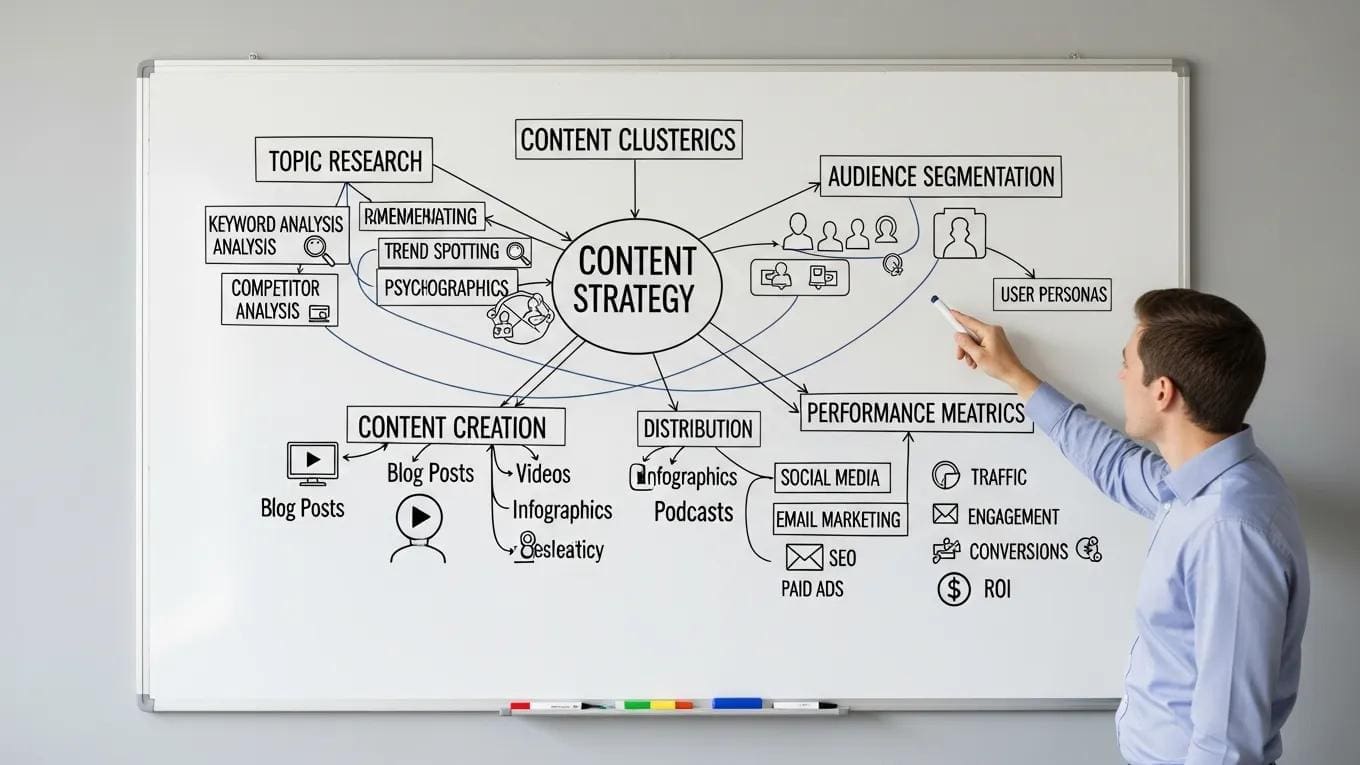
Organize related pages into topical clusters to build authority and cover multiple search intents within a coherent framework. Clusters make navigation easier and signal depth to search engines.
Well-planned clusters commonly increase dwell time and reduce bounce rates, both positive signals for organic visibility.
Analytics and KPIs
Measure SEO impact with analytics and KPIs: organic traffic, engagement, and conversions provide actionable evidence of what works. Use data to iterate on content and targeting.
Analytics platforms reveal user behavior and preferences; use those signals to prioritize updates and new content that align with audience needs.
Monitor these metrics regularly to evaluate the success of content optimization and prioritize interventions where impact is highest.
Marketing Automation
Marketing automation streamlines distribution and scheduling, freeing teams to focus on higher-value content. Automated workflows ensure consistent delivery and measurement across channels.
Tools support email campaigns, scheduling, and performance tracking, improving operational efficiency and campaign effectiveness.
Combining audits, intent-based content, clustering, and automation helps businesses increase organic traffic. Leveraging AI-driven platforms, including Cinderix, can further refine execution and sustain advantage.
Frequently Asked Questions
What is the role of AI in content optimization?
AI speeds analysis of large datasets to uncover keyword opportunities, audience segments, and personalization signals. It automates repetitive tasks so teams can focus on strategy and creative execution.
How can businesses measure the success of their SEO strategies?
Use KPIs such as organic traffic, engagement rate, and conversion rate. Analytics platforms (for example, Google Analytics) provide the behavioral data needed for evidence-based adjustments.
What are long-tail keywords and why are they important?
Long-tail keywords are specific multi-word phrases with clearer intent and lower competition. They attract niche, intent-driven traffic that often converts better than generic terms.
What is content clustering and how does it benefit SEO?
Clustering groups related content into topic hubs, increasing topical authority and enabling comprehensive coverage. This improves navigation and helps capture varied search intents.
How often should businesses conduct content audits?
Audit content regularly—typically every six to twelve months, depending on volume—to find gaps, prune obsolete pages, and refresh high-value assets.
What is intent-based targeting and why is it crucial for content creation?
Intent-based targeting categorizes keywords by purpose and guides format and messaging choices. Matching intent increases relevance, engagement, and conversion potential.
How can marketing automation improve content distribution?
Automation schedules and delivers content, manages campaigns, and gathers metrics automatically, reducing manual work and improving consistency and reach.
Conclusion
Effective content optimization, powered by AI and semantic techniques, aligns content with user intent to boost engagement and conversions. Regular audits, intent-focused targeting, and structured content clusters—combined with automation—help maintain relevance and grow organic traffic. Start a systematic optimization program to preserve competitive positioning.