
What Realistic Results Can Businesses Expect From Investing in SEO and Digital Marketing ROI Benchmarks
By Frank Wiebe, Cinderix
Investing in SEO and digital marketing is a strategic move that can yield significant returns for businesses. Understanding the realistic outcomes of these investments, including the SEO results timeline and how to measure digital marketing ROI, is crucial for setting expectations and measuring success. This article delves into the various aspects of SEO and digital marketing, including clear timelines for results, methods for measuring ROI, and the impact of AI-driven marketing. Many businesses struggle to quantify the benefits of their marketing efforts, leading to uncertainty about their investments. By exploring the phases of SEO results, effective measurement techniques, and the role of advanced technologies, this guide aims to provide clarity and actionable insights. We will cover the typical SEO results timeline with specific milestones, how to measure digital marketing effectiveness, the enhancement of outcomes through AI, the importance of revenue infrastructure, common pitfalls that cause SEO underperformance, and real-world case studies demonstrating success.
Research further emphasizes the critical role of digital transformation, web analytics, and SEO in driving growth for small and medium-sized enterprises.
SEO & Web Analytics Impact on SME Growth
This study investigates the pivotal role of digital transformation in marketing, with a particular focus on the impact of web analytics and Search Engine Optimization (SEO) on SME growth trajectories. Through a comprehensive review of 85 peer-reviewed academic articles, industry reports, and relevant case studies, the study synthesizes a broad spectrum of insights into how SMEs leverage digital tools and data-driven strategies to expand market reach, enhance customer engagement, and sustain long-term business performance.
Digital transformation in marketing: evaluating the impact of web analytics and SEO on SME growth, AJ Mou, 2022
What Is the Typical SEO Results Timeline for Business Growth?
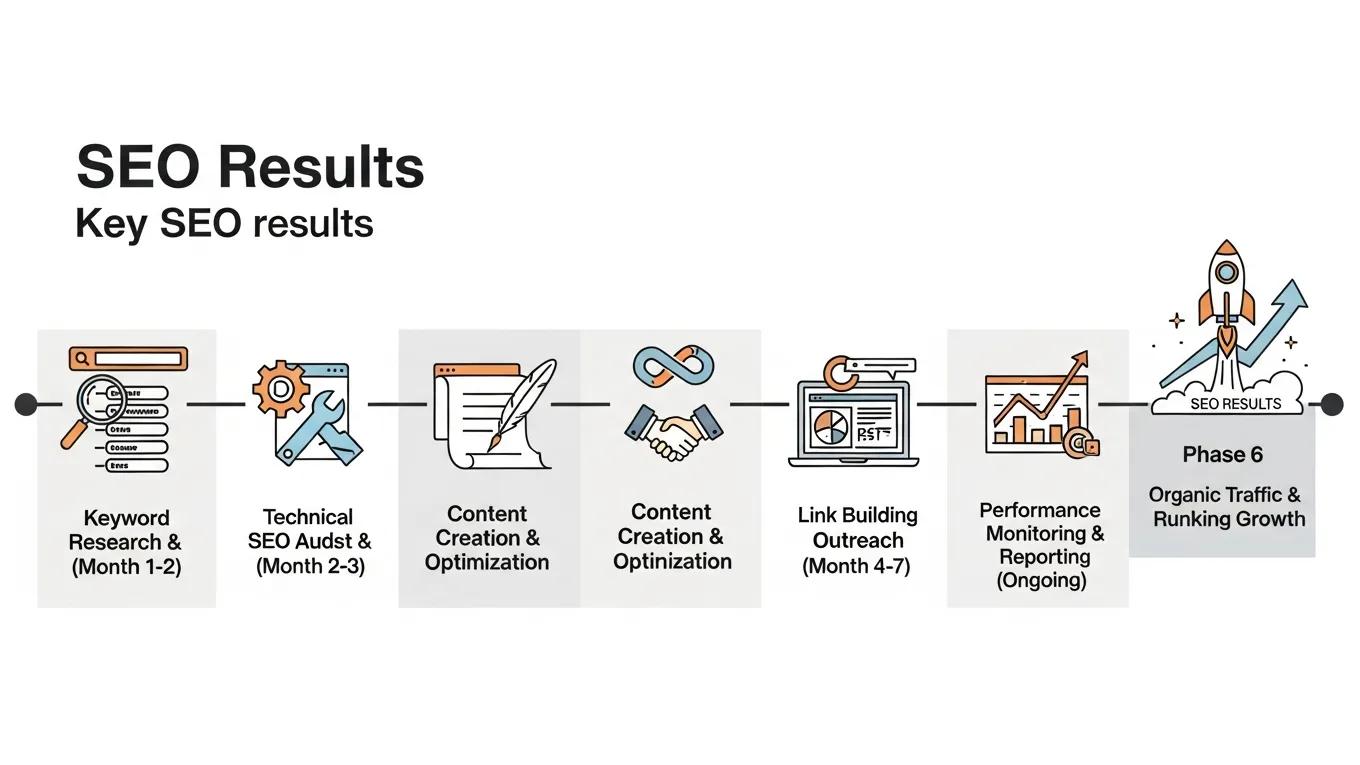
The SEO results timeline is a critical aspect for businesses to understand as they embark on their digital marketing journey. SEO is not an overnight solution; it involves a series of phases that contribute to gradual growth. Typically, businesses can expect to see initial improvements within a few months, but substantial results often take longer to materialize. Understanding this timeline helps set realistic expectations and prepares businesses for the long-term commitment required for effective SEO.
SEO Results Timeline: Key Milestones and Realistic Outcomes
Breaking down the SEO results timeline into clear phases with specific milestones helps businesses anticipate progress and plan accordingly. Here is a structured timeline with realistic outcomes for each phase:
- Months 1-3: Foundation and Initial GainsKeyword research and strategy development completed.Content creation and on-page optimization underway.Initial technical SEO fixes implemented.Early improvements in website traffic and search visibility begin to appear.Establishment of baseline metrics for ongoing measurement.
- Months 3-6: Growth and Authority BuildingContent volume increases with targeted, optimized pages.Link building efforts start to generate quality backlinks.Domain authority begins to improve, enhancing rankings.Noticeable increases in organic traffic and engagement metrics.Early conversions and lead generation from SEO channels become measurable.
- Months 6-12: Scaling and Sustained ResultsOngoing content optimization and expansion into new keyword areas.Robust backlink profile established, strengthening domain authority.Consistent growth in organic traffic, leads, and revenue attributed to SEO.SEO becomes a significant contributor to overall marketing ROI.Long-term strategies for scaling and adapting to market changes are implemented.
Understanding these milestones allows businesses to set realistic expectations and align their marketing efforts with achievable goals over time.
How Can Businesses Accurately Measure Digital Marketing ROI and Effectiveness?
Measuring the digital marketing ROI of efforts is essential for understanding their effectiveness and justifying investments. Businesses need to identify key metrics and tools that provide insights into their marketing performance. By accurately measuring ROI, companies can make informed decisions about their marketing strategies and allocate resources more effectively.
What Metrics and Tools Are Essential for Measuring Digital Marketing ROI?
To effectively measure digital marketing ROI, businesses should focus on several key performance indicators (KPIs):
- Traffic Metrics: Analyzing website traffic helps determine the effectiveness of marketing campaigns in attracting visitors.
- Engagement Rates: Metrics such as bounce rate and time on site provide insights into how well content resonates with the audience.
- Conversion Rates: Tracking the percentage of visitors who complete desired actions (e.g., purchases, sign-ups) is crucial for measuring success.
- Customer Acquisition Cost (CAC): Understanding how much it costs to acquire a new customer helps evaluate the efficiency of marketing efforts.
- Customer Lifetime Value (CLV): This metric estimates the total revenue a business can expect from a customer over their relationship, providing a long-term view of ROI.
What Are Industry Benchmarks for Digital Marketing ROI Performance?
Industry benchmarks for digital marketing ROI can vary significantly based on the sector and specific marketing strategies employed. However, some general benchmarks include:
- Average ROI: Many businesses aim for an ROI of 5:1, meaning for every dollar spent, they expect to earn five in return.
- Factors Influencing ROI: Elements such as industry competition, target audience, and marketing channels can impact ROI performance.
- Comparison with Industry Standards: Regularly comparing performance against industry standards helps businesses identify areas for improvement and adjust strategies accordingly.
This approach is further supported by research highlighting the importance of benchmarks for interpreting ROI results and identifying areas for improvement.
Digital Marketing ROI Benchmarks & Measurement
This section also delves into the role of benchmarks, which provide a crucial context for interpreting ROI results. By comparing campaign performance against industry averages or historical data, businesses can gain a clearer understanding of their effectiveness and identify areas for improvement.
Evaluating ROI in digital marketing campaigns: metrics, measurement, and insights, KK Ramachandran, 2023
Integrating an AI-driven marketing system can enhance these measurement efforts by providing advanced analytics and insights.
How Does AI-Driven Marketing Enhance SEO and Digital Marketing Outcomes?

AI-driven marketing is revolutionizing how businesses approach SEO and digital marketing. By leveraging advanced technologies, companies can optimize their strategies and achieve better results. AI enhances marketing efficiency, improves targeting, and provides valuable insights that drive decision-making.
Indeed, studies show that AI-enabled strategic pathways are crucial for transitioning marketing from a brand-centric function to a scalable, revenue-driven growth engine.
AI-Enabled Marketing for Revenue Growth & Measurable Impact
The increasing demand for measurable business impact has transformed marketing from a brand-centric function into a revenue-driven growth engine. This study investigates how AI-enabled strategic pathways facilitate the transition from traditional brand building to scalable revenue growth in modern marketing organizations. The findings reveal that while brand equity significantly contributes to performance, AI Capability Maturity emerges as the strongest predictor of revenue growth, both directly and indirectly through Customer Intelligence Integration.
FROM BRAND BUILDING TO REVENUE GROWTH: AI-ENABLED STRATEGIC PATHWAYS FOR SCALING MODERN MARKETING ORGANIZATIONS, 2024
In What Ways Does AI Improve Marketing Efficiency and ROI?
AI improves marketing efficiency in several ways:
- Automation of Routine Tasks: AI can automate repetitive tasks such as data analysis and reporting, freeing up time for marketers to focus on strategy.
- Improved Keyword Ranking and Traffic: AI algorithms can analyze search patterns and optimize content for better visibility, leading to increased traffic.
- Enhanced User Engagement: AI tools can personalize user experiences, improving engagement and conversion rates.
- Data-Driven Decision Making: AI provides actionable insights based on data analysis, allowing businesses to make informed marketing decisions.
How Do AI Marketing Systems Integrate With Revenue Infrastructure Models?
AI marketing systems can seamlessly integrate with revenue infrastructure models to enhance overall marketing effectiveness. This integration allows businesses to:
- Optimize Keyword Strategies: AI can analyze keyword performance and suggest adjustments to improve rankings.
- Personalize Content: By understanding user behavior, AI can help create tailored content that resonates with target audiences.
- Utilize Predictive Analytics: AI can forecast trends and customer behavior, enabling proactive marketing strategies that align with revenue goals.
What Role Does Revenue Infrastructure Play in Maximizing Marketing Investments?
Revenue infrastructure is a foundational element that supports effective marketing strategies. It encompasses the systems and processes that enable businesses to generate and manage revenue effectively. A well-structured revenue infrastructure maximizes the impact of marketing investments and drives sustainable growth.
How Do Integrating Marketing and Sales Teams Drive Revenue Growth?
Integrating marketing and sales teams is essential for driving revenue growth. This collaboration can be achieved through:
- Shared Goals: Establishing common objectives ensures that both teams work towards the same outcomes.
- Regular Communication: Frequent updates and discussions foster alignment and collaboration between teams.
- Cross-Training: Providing training opportunities for both teams enhances understanding and cooperation, leading to improved results.
What Are Best Practices for Building a Revenue Infrastructure?
Building a robust revenue infrastructure involves several best practices:
- Conduct Market Research: Understanding market dynamics and customer needs is crucial for developing effective strategies.
- Set Measurable Objectives: Establishing clear, quantifiable goals helps track progress and success.
- Utilize Integrated Technology: Implementing technology solutions that connect marketing and sales processes enhances efficiency and effectiveness.
Common Reasons Why SEO Underperforms and How Cinderix Stands Apart
Despite the potential of SEO, many businesses experience underwhelming results due to common pitfalls. Understanding these challenges is key to avoiding wasted investment and achieving sustainable growth.
- Poor Strategy and Planning: Without a clear, data-driven SEO strategy aligned with business goals, efforts can be unfocused and ineffective.
- Choosing the Wrong Agency or Partner: Agencies lacking transparency, expertise, or a tailored approach often deliver subpar results.
- Neglecting Technical SEO: Overlooking website health, speed, and crawlability can hinder search engine rankings.
- Inadequate Content Quality and Relevance: Content that does not meet user intent or lacks optimization fails to attract and engage visitors.
- Ignoring Analytics and Continuous Optimization: SEO requires ongoing monitoring and adjustment; failure to do so leads to stagnation.
At Cinderix, we differentiate ourselves by providing transparent, expert-driven SEO services tailored to your unique business needs. Our approach combines strategic planning, technical excellence, high-quality content creation, and continuous performance analysis to ensure your SEO investment delivers measurable, long-term results.
What Are Real-World Case Studies Demonstrating SEO and Digital Marketing Success?
Real-world case studies provide valuable insights into the effectiveness of SEO and digital marketing strategies. By examining successful examples, businesses can learn from others’ experiences and set realistic expectations for their own marketing investments.
Which Case Studies Illustrate Measurable ROI Improvements?
Several case studies highlight measurable ROI improvements through effective SEO and digital marketing strategies:
- E-commerce Brand: A leading e-commerce brand implemented a comprehensive SEO strategy, resulting in a 150% increase in organic traffic and a 200% increase in sales over six months.
- Local Service Provider: A local service provider optimized their website for local search, leading to a 50% increase in leads and a 30% increase in revenue within three months.
- SaaS Company: A SaaS company utilized targeted content marketing and SEO, achieving a 300% increase in trial sign-ups and a 150% increase in conversions over a year.
How Do These Examples Inform Realistic Expectations for Marketing Investments?
These case studies illustrate that while results can vary, significant improvements are achievable with the right strategies. Businesses should set realistic expectations based on their industry, competition, and specific marketing efforts. Understanding the potential for growth and the factors that influence success can help businesses make informed decisions about their marketing investments.
Frequently Asked Questions About SEO Results Timeline and Digital Marketing ROI
How long does it typically take to see results from SEO efforts?
Most businesses begin to see initial SEO improvements within 1 to 3 months, with more substantial growth and ROI typically occurring between 6 to 12 months, depending on the industry, competition, and strategy execution.
What factors influence the digital marketing ROI for my business?
Digital marketing ROI is influenced by factors such as the quality of your SEO strategy, the competitiveness of your market, the effectiveness of your content, your conversion optimization, and how well you measure and adjust campaigns over time.
Why might SEO underperform despite investment?
SEO can underperform due to poor strategy, choosing the wrong agency, neglecting technical SEO, producing low-quality content, or failing to monitor and optimize campaigns continuously.
How can AI-driven marketing improve my SEO and ROI?
AI-driven marketing enhances SEO by automating routine tasks, improving keyword targeting, personalizing user experiences, and providing data-driven insights that help optimize campaigns for better ROI.
Partner with Cinderix: Your Trusted SEO and Digital Marketing Expert
Achieving realistic, measurable results from SEO and digital marketing requires expertise, transparency, and a tailored approach. At Cinderix, we combine strategic planning, advanced technology, and continuous optimization to maximize your marketing ROI and drive sustainable business growth. Ready to transform your digital presence and see real results? Contact Cinderix Today